
Table of Contents
Email Marketing for Small Business
Email marketing remains one of the highest-ROI digital channels for small businesses because it allows direct, permission-based communication with customers. Unlike social media algorithms that limit organic reach, email gives businesses full control over their audience and messaging.
For startups and local businesses in markets like India, USA, and the UK, email marketing is cost-effective, measurable, and scalable. Whether promoting new products, offering seasonal discounts, or nurturing leads, small businesses can build long-term relationships by delivering personalized and relevant content directly to inboxes.
Small Business Email Marketing Strategy & Tips for 2026
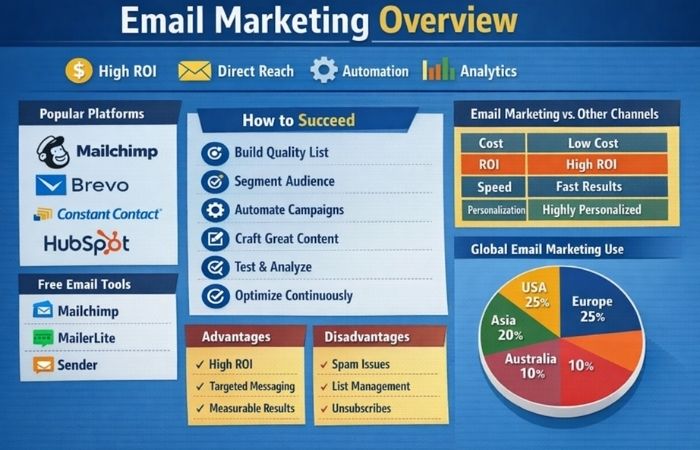
In 2026, small business email marketing strategies are increasingly powered by automation and AI-driven personalization. Tools like Mailchimp and Brevo allow businesses to segment audiences based on behavior, purchase history, and engagement levels. Interactive emails, mobile-first design, and hyper-personalized product recommendations are becoming standard. Privacy regulations such as General Data Protection Regulation and California Consumer Privacy Act also require transparent consent practices. In 2026, success depends on automation workflows, first-party data collection, and value-driven content rather than aggressive promotions.
Email Marketing Strategies for Success
Successful email marketing strategies combine list building, segmentation, personalization, and performance tracking. Businesses should focus on growing high-quality subscriber lists through lead magnets, website pop-ups, and checkout opt-ins. Segmentation improves open rates by sending targeted messages to specific audience groups. A/B testing subject lines, call-to-action buttons, and send times helps optimize performance. Metrics such as open rate, click-through rate, and conversion rate guide improvement. Most importantly, consistency and relevance determine long-term engagement.
Free Email Marketing Tools for Small Business
| Tool | Free Plan Limit | Best For | Key Feature |
| Mailchimp | 500 contacts | Beginners | Templates + Automation |
| Brevo | 300 emails/day | Transactional emails | SMS + Email |
| MailerLite | 1,000 subscribers | Bloggers | Drag-and-drop builder |
| Benchmark Email | 500 contacts | Small startups | Basic automation |
| Sender | 2,500 subscribers | Ecommerce | High deliverability |
Email Marketing vs Other Marketing Channels
| Factor | Email Marketing | Social Media | Paid Ads | SEO |
| Cost | Low | Low–Medium | High | Medium |
| ROI | Very High | Medium | Variable | High (long term) |
| Audience Control | Full | Limited (algorithm) | Platform dependent | Search engine dependent |
| Speed of Results | Fast | Fast | Immediate | Slow |
| Personalization | High | Medium | Medium | Low |
Email campaigns can also be combined with SMS marketing to create coordinated customer communication across multiple direct marketing channels.
How to Create an Effective Email Marketing Strategy
| Step | Action | Goal |
| 1 | Define target audience | Clear segmentation |
| 2 | Build email list ethically | Quality subscribers |
| 3 | Choose platform | Automation + Analytics |
| 4 | Design mobile-friendly templates | Better engagement |
| 5 | Create content calendar | Consistency |
| 6 | Automate campaigns | Efficiency |
| 7 | Track metrics | Continuous improvement |
Businesses looking for a practical framework can also review these email marketing plan basics to structure campaigns, content, audience targeting, and performance tracking.
Worldwide Comparison on Email Marketing Strategy
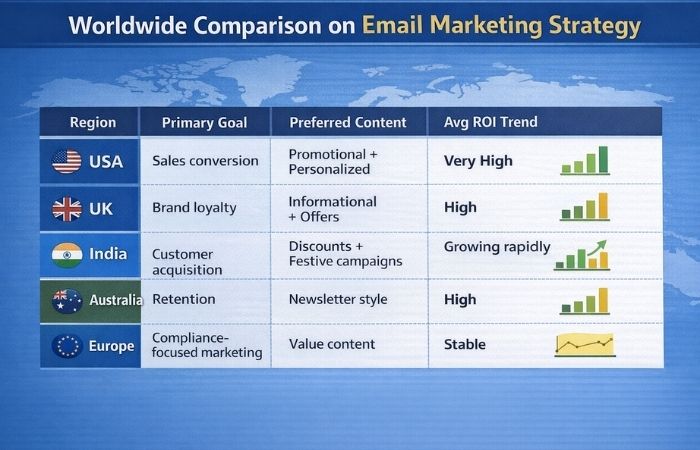
| Region | Primary Goal | Preferred Content | Avg ROI Trend |
| USA | Sales conversion | Promotional + Personalized | Very High |
| UK | Brand loyalty | Informational + Offers | High |
| India | Customer acquisition | Discounts + Festive campaigns | Growing rapidly |
| Australia | Retention | Newsletter style | High |
| Europe | Compliance-focused marketing | Value content | Stable |
Advantages and Disadvantages of Email Marketing Strategies
| Advantages | Disadvantages |
| High ROI | Spam filters |
| Direct communication | Requires list building |
| Automation friendly | Compliance regulations |
| Measurable results | Design & copy effort |
| Personalization | Unsubscribes |
Email Marketing Jobs, Companies & Salaries
| Job Role | Companies Hiring | Avg Salary (USA) | Avg Salary (India) |
| Email Marketing Specialist | Amazon | $60,000–$80,000 | ₹5–8 LPA |
| CRM Manager | Shopify | $85,000–$110,000 | ₹10–18 LPA |
| Marketing Automation Manager | Salesforce | $95,000–$130,000 | ₹12–22 LPA |
| Digital Marketing Executive | Flipkart | $50,000–$65,000 | ₹4–6 LPA |
Anyone planning a career in this field can also explore the key email marketing specialist skills needed to manage campaigns, automation, analytics, segmentation, and customer communication.
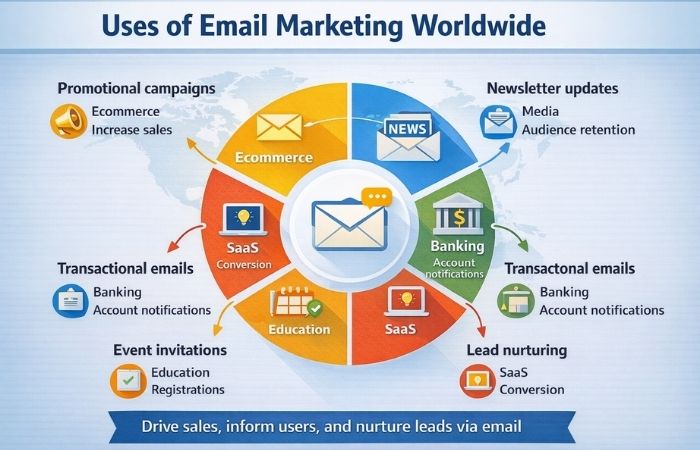
Uses of Email Marketing Worldwide