


Table of Contents
Introduction
Digital marketing is no longer optional for startups—it is survival infrastructure. In the early stages of a business, visibility determines viability. Unlike traditional advertising, digital marketing allows startups to compete with established brands using strategy, creativity, and data rather than massive budgets. From search engines to social media and automation tools, startups today can reach global audiences, test ideas instantly, and scale faster than ever before. The key is choosing the right strategies at the right time.
Best Digital Marketing Strategies for Startup Businesses
| Strategy | Purpose | Cost Level | Best For | Expected ROI Timeline |
| SEO (Search Engine Optimization) | Organic traffic growth | Medium | Long-term brand building | 3–6 months |
| Content Marketing | Authority & trust building | Low–Medium | Education-based brands | 2–4 months |
| Social Media Marketing | Brand awareness & engagement | Low | B2C startups | 1–3 months |
| PPC Advertising | Immediate traffic | High | Product launches | Immediate |
| Email Marketing | Lead nurturing & retention | Low | SaaS & service startups | 1–2 months |
| Influencer Marketing | Social proof & reach | Medium | Lifestyle brands | 1–3 months |
| Affiliate Marketing | Performance-based growth | Low | E-commerce | 2–4 months |
Top 5 Digital Marketing Strategies for Startups
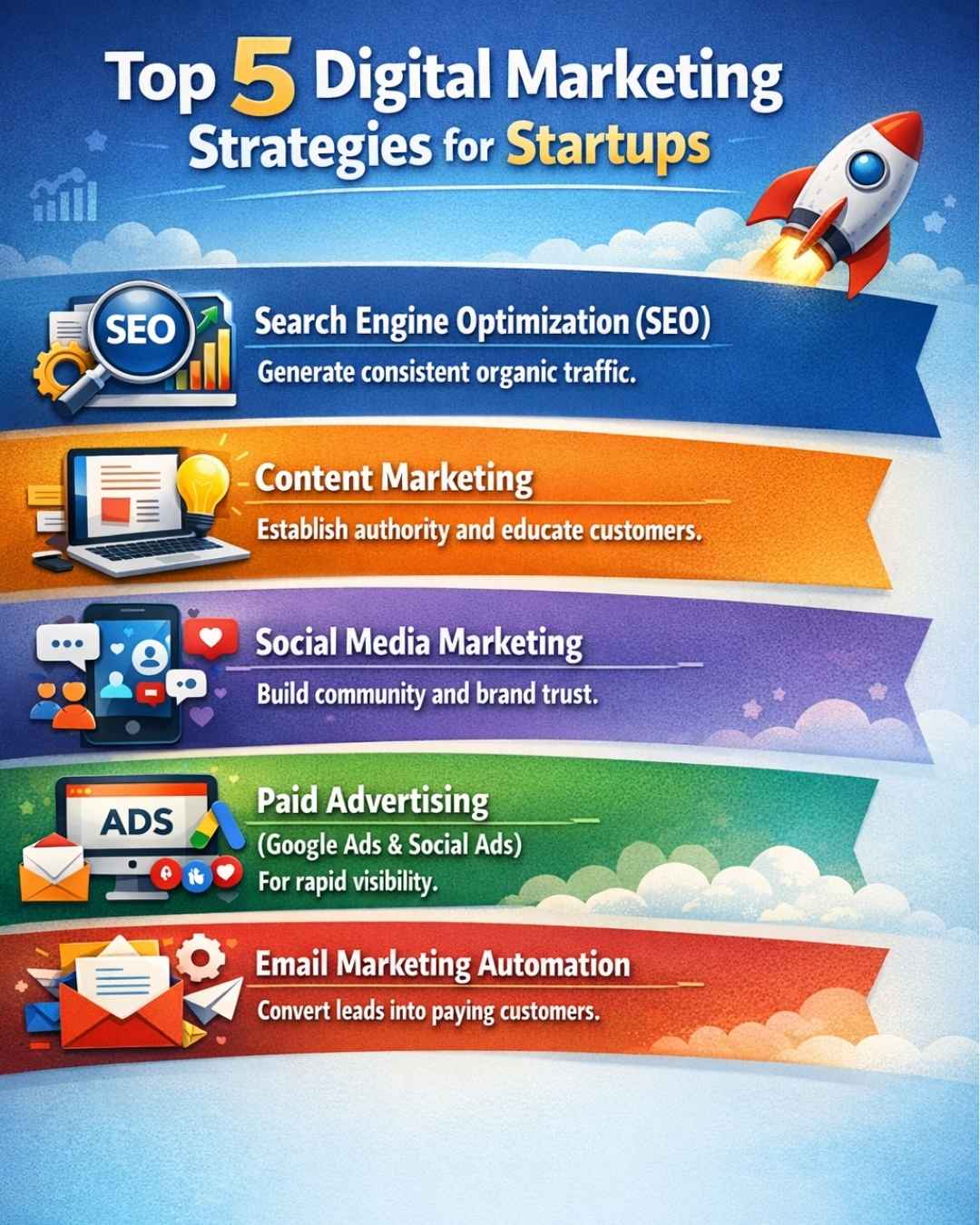
- Search Engine Optimization (SEO) to generate consistent organic traffic.
- Content Marketing to establish authority and educate customers.
- Social Media Marketing to build community and brand trust.
- Paid Advertising (Google Ads and Social Ads) for rapid visibility.
- Email Marketing Automation to convert leads into paying customers.
The Future of Digital Marketing in Startups
The future of digital marketing for startups is data-driven, AI-assisted, and hyper-personalized. Automation tools now allow even small teams to run sophisticated campaigns. AI-powered analytics can predict customer behavior, optimize ads in real time, and personalize email journeys.
Short-form video, community-based marketing, and conversational commerce will dominate. Startups that combine human storytelling with AI efficiency will outperform competitors. Privacy regulations and cookieless tracking will also reshape targeting strategies, forcing startups to focus more on first-party data and authentic engagement.
Digital Marketing Courses for Startups
| Course | Platform | Level | Best For |
| Fundamentals of Digital Marketing | Google Digital Garage | Beginner | Founders & early teams |
| Inbound Marketing Certification | HubSpot Academy | Beginner–Intermediate | SaaS startups |
| Meta Blueprint Certification | Meta Blueprint | Intermediate | Social media marketers |
| Digital Marketing Specialization | Coursera | Intermediate | Structured learning |
| Complete Digital Marketing Course | Udemy | Beginner | Budget-friendly learners |
Best Tools for Digital Marketing Strategies for Startups
| Tool | Category | Best For | Pricing Type |
| Google Analytics | Analytics | Website traffic insights | Free |
| Ahrefs | SEO | Keyword & backlink research | Paid |
| Mailchimp | Email Marketing | Automation & newsletters | Freemium |
| Canva | Graphic Design | Social media creatives | Freemium |
| Hootsuite | Social Media | Scheduling & monitoring | Paid |
Pros and Cons of Digital Marketing Strategies
| Pros | Cons |
| Cost-effective compared to traditional ads | High competition in most niches |
| Global reach | Requires continuous monitoring |
| Real-time performance tracking | Algorithm changes affect performance |
| Highly targeted audience segmentation | Can be time-consuming |
| Scalable campaigns | Paid ads can become expensive |
Local vs Global Digital Marketing Strategies
| Factor | Local Digital Marketing | Global Digital Marketing |
| Target Audience | Specific city/region | Multiple countries or worldwide |
| SEO Focus | Local SEO (Google Business Profile, location keywords) | International SEO (hreflang, multilingual content) |
| Advertising | Geo-targeted ads | Multi-country paid campaigns |
| Content Strategy | Local culture & language focused | Cultural adaptation & localization |
| Competition | Lower but niche-focused | High and diverse |
| Budget | Lower initial cost | Higher due to scaling & translation |
| Tools Used | Google Business Profile, local influencers | Google Ads, global CRM systems |
| Example | Restaurant targeting Hyderabad customers | SaaS startup targeting USA, UK & India |
What Are Common Digital Marketing Mistakes Startups Make?
Ignoring a Clear Target Audience: Many startups try to target everyone, which weakens messaging and ad performance.
Not Investing in SEO Early: Delaying SEO means losing long-term organic growth opportunities.
Over-Relying on Paid Ads: Paid traffic without retention strategy leads to high acquisition costs.
Inconsistent Branding: Different messaging across platforms reduces trust.
Ignoring Data & Analytics: Tools like Google Analytics provide insights, yet many startups fail to track KPIs properly.
No Email List Building: Startups often ignore email marketing, despite it being one of the highest ROI channels.
Unrealistic Expectations: Expecting viral growth in weeks instead of consistent optimization.
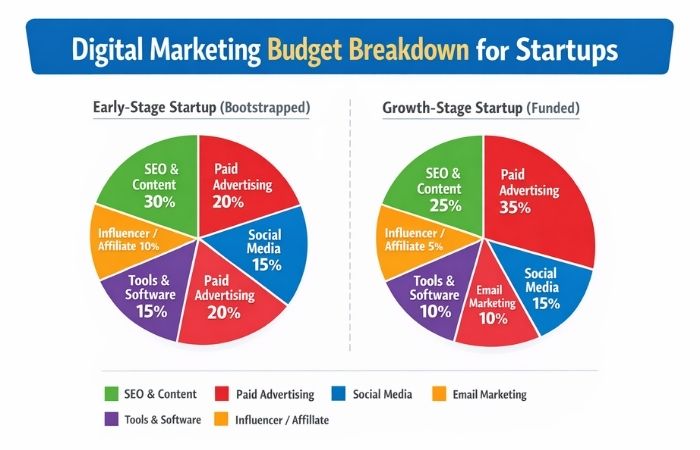
Digital marketing budget breakdown for startups
Startups vs Entrepreneurs
| Factor | Startups | Entrepreneurs |
| Definition | Scalable business model | Individual business creator |
| Growth Goal | Rapid scaling | Sustainable growth |
| Funding | Often venture-backed | Self-funded or small investors |
| Risk Level | High risk, high reward | Moderate risk |
| Innovation Focus | Disruptive innovation | Can be traditional or innovative |
Conclusion
Digital marketing empowers startups to compete, scale, and build global brands without massive budgets. The right mix of SEO, content, paid ads, and automation creates sustainable growth. As AI and personalization shape the future, startups that adapt quickly and focus on customer experience will win.
FAQ
- What is the best digital marketing strategy for startups?
SEO combined with content marketing provides long-term sustainable growth.
- Is digital marketing expensive for startups?
It can start low-cost, but paid ads require budget management.
- How long does SEO take to show results?
Typically 3–6 months for noticeable growth.
- Which platform is best for startup advertising?
It depends on the audience, but Google Ads and social media platforms are common choices.
- Can startups manage digital marketing without hiring an agency?
Yes, with the right tools and online courses, founders can manage initial campaigns themselves.