



In today’s digital landscape, content is the engine that drives brand awareness, customer loyalty, and sales. For small businesses operating with limited budgets and manpower, a smart content strategy is not just a marketing tactic—it is a necessity for survival and growth. This guide breaks down everything you need to know about content creation, from the “why” to the “how.”
Table of Contents
What Is Content Creation and Why Is It Important for Small Businesses?
Content creation is the process of generating topic ideas that appeal to your buyer persona and creating written, visual, or audio material around those ideas. This includes blog posts, videos, social media updates, emails, podcasts, and infographics.
For small businesses, content creation is the bridge between your product and your customer. It allows you to:
-
- Educate your audience about your industry and solutions.
- Build trust by showcasing your expertise.
- Compete with larger companies by providing more value, not just lower prices.
Benefits of Content Creation for Small Businesses
Here is how consistent content creation directly impacts your bottom line:
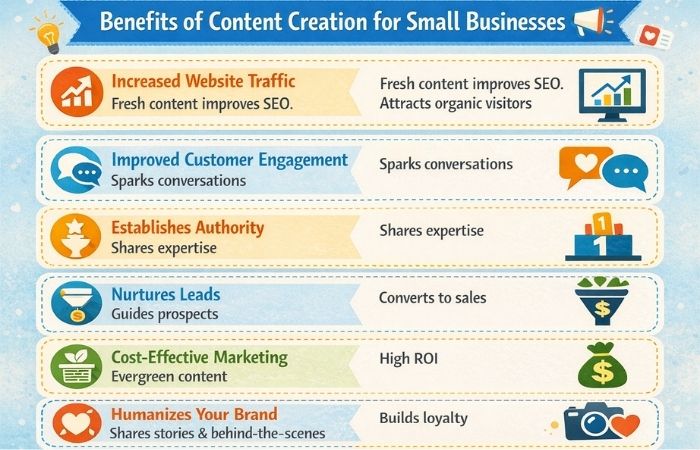
| Benefit | Description | Impact on Small Business |
|---|---|---|
| Increased Website Traffic | Fresh content (blogs, videos) gives Google more pages to index, improving SEO. | Attracts organic visitors without paying for ads. |
| Improved Customer Engagement | Social media posts and emails spark conversations. | Builds a community around your brand. |
| Establishes Authority | Sharing industry knowledge positions you as an expert. | Makes customers choose you over competitors. |
| Nurtures Leads | Email sequences and gated content guide prospects to a purchase. | Converts strangers into paying customers. |
| Cost-Effective Marketing | A single blog post can generate traffic for years (evergreen content). | Provides a high return on investment (ROI) compared to traditional ads. |
| Humanizes Your Brand | Behind-the-scenes content and stories make your business relatable. | Fosters emotional connections and loyalty. |
How Small Businesses Can Master Content Creation
Mastering content creation isn’t about doing everything; it’s about doing the right things consistently.
| Step | Actionable Strategy |
|---|---|
| 1. Define Your Audience | Create a detailed buyer persona. Who are they? What keeps them up at night? |
| 2. Set Clear Goals | Decide what you want: Brand awareness? Sales? Email signups? (SMART goals). |
| 3. Choose Your Channels | Don’t be everywhere. If your customers are visual, focus on Instagram. If they are professionals, use LinkedIn. |
| 4. Create a Content Mix | Use the 80/20 rule: 80% of content should inform, educate, or entertain; 20% can promote your products. |
| 5. Batch Create | Dedicate one day a month to writing all blogs or filming all videos to save time. |
| 6. Repurpose Content | Turn a blog post into a LinkedIn carousel, a podcast episode, and 5 Twitter threads. |
How to Create Content for Small Business
A systematic approach ensures you never run out of ideas.
| Phase | Task | Example |
|---|---|---|
| Ideation | Brainstorm topics based on customer FAQs, industry news, or keyword research. | A bakery might research “gluten-free birthday cakes near me.” |
| Creation | Write the blog, record the video, or design the graphic. Focus on high-quality audio/visuals. | Use a smartphone with good lighting for videos. |
| Optimization | Add keywords, meta descriptions, and alt text for SEO. Ensure the content is scannable. | Break text into bullet points and short paragraphs. |
| Distribution | Share it on your chosen channels. Email it to your subscribers. | Post the blog link on Facebook and in your newsletter. |
| Analysis | Check analytics to see what performed well. Did people watch the video to the end? | Use insights to create more of what works. |
When Should Small Businesses Focus on Content Creation?
-
-
- When launching a new product: Build hype and educate customers on how to use it.
- During slow seasons: Use this time to create “evergreen” content that will drive traffic when business picks up.
- When you have expertise to share: If a staff member has unique knowledge, capture it immediately.
- Consistently: The algorithm rewards consistency. It is better to post once a week every week than to post five times one week and nothing for a month.
-
Where to Start with Content Creation as a Small Business?
Feeling overwhelmed? Start here.
| Step | Action |
|---|---|
| Audit Existing Assets | Do you have photos from an event? A FAQ list you can turn into a blog? |
| Listen to Customers | Write down the top 10 questions customers ask you. These are your first 10 blog topics. |
| Pick One Platform | Master one social platform before moving to the next. |
| Create a Content Calendar | Plan one month at a time. Use a simple Google Sheet or a tool like Trello. |
| Just Start | Don’t wait for perfection. A good video posted today is better than a perfect video posted never. |
Why Content Creation is Essential for Small Business Success?
In the digital age, if a business doesn’t exist online, it doesn’t exist at all. Content creation is essential because it:
-
- Builds Digital Real Estate: Your content (blogs, videos) are assets you own (unlike followers on social media, which can be taken away).
- Fuels the Sales Funnel: It attracts strangers (Top of Funnel), nurtures leads (Middle), and converts customers (Bottom).
- Provides Social Proof: User-generated content and reviews act as powerful endorsements.
- Adapts to Changing Algorithms: Whether Google updates its search rules or Instagram changes its feed, high-quality content remains the king.
Who Can Help Small Businesses with Content Creation?
You don’t have to do it all alone.
-
-
- Freelancers (Upwork, Fiverr): Hire writers, graphic designers, or video editors for specific projects.
- Marketing Agencies: Outsource your entire content strategy for a monthly retainer.
- Interns: Local college students studying marketing often need real-world experience.
- AI Tools: Use tools like ChatGPT or Jasper to generate ideas and outlines (but always add a human touch/edit before posting).
- Your Team: Encourage staff to contribute ideas or appear in videos.
-
Content Creation Tips for Small Businesses
| Tip | Why It Works |
|---|---|
| Tell Stories, Don’t Just Sell | Stories are memorable. Share the story of why you started the business. |
| Focus on Value over Virality | One piece of content that solves a problem is worth more than a viral meme that people forget. |
| User-Generated Content (UGC) | Repost customer photos and reviews. It’s free and authentic. |
| Use a Consistent Brand Voice | Whether you are witty or professional, stick to it so people recognize you. |
| Optimize for Mobile | Most people view content on phones. Ensure images and text are readable. |
| Include a Call to Action (CTA) | Always tell them what to do next: “Read more,” “Shop now,” “Comment below.” |
Content Creation Tools for Small Businesses
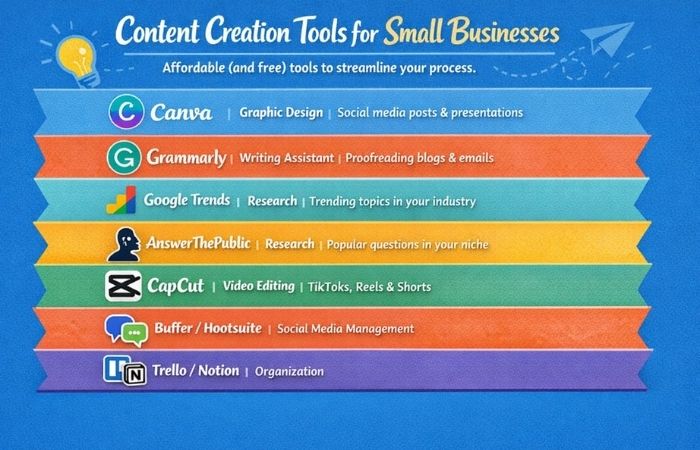
Here are affordable (and free) tools to streamline your process.
| Tool Name | Purpose | Best For |
|---|---|---|
| Canva | Graphic Design | Creating social media posts, flyers, and presentations easily. |
| Grammarly | Writing Assistant | Proofreading blogs and emails for grammar and tone. |
| Google Trends | Research | Finding out what topics are currently popular in your industry. |
| AnswerThePublic | Research | Discovering what questions people are asking about your niche. |
| CapCut | Video Editing | Editing short-form videos for TikTok, Reels, and Shorts (free). |
| Buffer/Hootsuite | Social Media Management | Scheduling posts in advance to save time. |
| Trello/Notion | Organization | Managing your content calendar and workflow. |
Conclusion
Content creation for small businesses is not just about keeping up with trends; it is about building meaningful connections with your community. By providing consistent value, telling your unique story, and strategically using the tools and tips above, you can turn your small business into a trusted authority in your niche.
Start small, stay consistent, and remember: every piece of content is an investment in your business’s future. Your voice matters—start using it today.
FAQs
1. How often should a small business post content?
Quality over quantity. For beginners, aim for 1 blog post per week and 3-5 social media posts per week. Consistency is more important than frequency.
2. What type of content is best for a small budget?
Video and User-Generated Content. Short-form video (Reels, TikToks) shot on a smartphone has the highest organic reach right now. Sharing customer photos is free and effective.
3. How do I measure if my content is working?
Track these key metrics:
-
-
- Traffic: Website visitors (Google Analytics).
- Engagement: Likes, shares, comments, saves.
- Conversions: Email signups, contact form fills, sales.
-
4. Can I use AI to write my content?
Yes, AI is great for generating outlines and ideas, but you should always edit the content to add your personal voice, expertise, and specific local knowledge. Google favors helpful, people-first content.
5. How do I find ideas for content?
Listen to your customers. The questions they ask you in person or via email are the exact topics you should write about. Also, check out what your competitors are posting and see how you can do it better.